



Rosh Chodesh, the sanctification of the new moon, is one of the most spiritually charged moments in the Jewish calendar.
It is far more than a date on a calendar or a liturgical formality. In the teachings of the Kabbalists, Rosh Chodesh marks a quantum renewal, a monthly rebirth of the Shechinah herself, and an opening of new channels of Divine light into the world.
The very first commandment given to the Jewish people as a nation, even before the Exodus from Egypt, was the sanctification of the new moon. The verse reads: “This month shall be for you the head of months” (Exodus 12:2). The Zohar (Parashat Bo) explains that this commandment was given specifically to empower Israel with the ability to renew time itself, to draw holiness into the cycle of months and seasons, and to align the flow of the lower world with the rhythms of the upper one.
What follows is an exploration of the deeper dimensions of Rosh Chodesh as understood by the classical Kabbalists: the Zohar, the Arizal, the Rashash, the Ben Ish Chai, and Rebbe Nachman of Breslov.

The Diminishment of the Moon
To understand Rosh Chodesh, we must first understand the moon. The Talmud (Chulin 60b) records a remarkable passage. On the fourth day of creation, the Torah states that God made “the two great luminaries” (Genesis 1:16). But the verse immediately continues: “the great luminary… and the small luminary.” How can they be both great and small?
The Talmud explains: the sun and moon were originally created equal in stature. The moon then came before the Holy One, blessed be He, and said: “Master of the Universe, is it possible for two kings to share a single crown?” God responded by telling the moon to diminish itself.
“The moon said before the Holy One, blessed be He: Master of the Universe, is it possible for two kings to share one crown? He said to her: Go and diminish yourself.”
(Talmud Bavli, Chulin 60b)
The moon protested. And in one of the most extraordinary passages in all of Talmudic literature, God acknowledged the seeming injustice. He commanded Israel to bring a special offering on Rosh Chodesh as an atonement, as it were, for the diminishment of the moon:
“The Holy One, blessed be He, said: Bring an atonement for Me, for I diminished the moon.”
(Talmud Bavli, Chulin 60b)
For the discerning reader, the Talmud is not merely talking about astral bodies, but about the Partzufim of Zeir Anpin (also known as the sun) and the Shekhina (also known as the moon). The Zohar (Bereishit) deepens this teaching immeasurably. The diminishment of the moon is not merely an astronomical event. It reflects a primordial contraction of its Partzuf, a necessary stage in the unfolding of creation that introduced separation, hierarchy, and the possibility of darkness, free will, work, reward and punishment.
Before the diminishment, Malchut shone with the same radiance as Zeir Anpin (the six Sefirot from Chesed through Yesod, which correspond to the sun). After it, she became a vessel that receives light rather than generating it. This is the root of all exile, all longing, and all spiritual distance in the world.
The Moon as Malchut: A Light That Receives
The correspondence between the moon and Malchut is one of the most fundamental teachings in Kabbalah. Just as the moon has no light of her own and reflects the light of the sun, so Malchut receives all her illumination from the higher Sefirot.
The Zohar repeatedly uses the moon as its primary symbol for the Shechinah. When the moon is full, it represents the Shechinah in a state of complete illumination, fully united with Zeir Anpin. When the moon wanes and disappears, it signifies the concealment of Divine presence, the withdrawing of the Shechinah from open revelation.
“When the moon is renewed, the Shechinah is renewed. And when the Shechinah is renewed, blessing descends to all the lower worlds.”
(Zohar, Parashat Pinchas)
This is why the waxing of the moon, from its disappearance at the end of the month to its gradual reappearance, is more than a physical phenomenon. It mirrors the very process through which the Shechinah is restored, step by step, from concealment to radiance. Every month, these events replays, offering those who understand it a chance to participate in the restoration of Divine light.
This all sheds light on why King Solomon finished and inaugurated the Holy Temple specifically on Yom Kippur, at the time when the moon is in its full glory. This likely represented the apex of the Jewish Kingdom, and instead of having to fast, the Jews celebrated with feasts.
Rosh Chodesh: The Moment of Renewal
The Arizal, Rabbi Yitzchak Luria, devoted extensive teachings to the spiritual dynamics of Rosh Chodesh. In Pri Etz Chaim (Sha’ar Rosh Chodesh), he explains that the moment of the new moon, the molad, represents the point at which Malchut begins to receive new light after a period of near-total concealment.
At the end of each lunar month, the moon disappears entirely. This corresponds to a state in which Malchut has descended to her lowest point and her light is hidden. At this juncture, Malchut returns, as it were, to the womb of Binah (Understanding), the supernal Mother. There she is reconstituted, renewed, and filled with new spiritual potential.
“On Rosh Chodesh, Malchut ascends to Binah and is renewed there, receiving new lights and new garments for the coming month.”
(Arizal, Pri Etz Chaim, Sha’ar Rosh Chodesh)
This is a process of genuine rebirth. The Shechinah does not merely resume her previous state. She is rebuilt from the ground up, each month receiving a unique configuration of light that corresponds to the particular spiritual character of that month. This is why each month carries its own distinct energy, its own letter, its own tribe, and its own sense, as outlined in Sefer Yetzirah.
The He-Goat of Rosh Chodesh: A Sacrifice Unlike Any Other
The Musaf (additional) offering of Rosh Chodesh, as described in Numbers 28:15, includes a striking element: a he-goat (se’ir izim) brought as a sin offering. The Torah’s exact words are: “and one he-goat as a sin offering to Hashem” (Numbers 28:15). The phrase “to Hashem” is unusual. Other sin offerings are described simply as sin offerings. This one is specified as being for God.
As we saw, the Talmud (Chulin 60b) interprets this to mean that God Himself, so to speak, is asking for atonement for having diminished the moon. The implications of this are staggering. It means that built into the very fabric of creation is a recognition by the Creator that the process of differentiation, the necessary contraction that allowed the world to exist, involved a kind of loss. The monthly offering of Rosh Chodesh is a Divine acknowledgment of that loss and a promise of its eventual restoration.
The Zohar (Parashat Pinchas) adds that the he-goat of Rosh Chodesh serves to pacify the forces of strict judgment (Dinim) and to prevent them from drawing sustenance from the holy side. By giving the Sitra Achra (the other side) its designated portion through this offering, the forces of holiness are freed to operate without interference. This is one of the deepest secrets of the sacrificial service: containment of judgment so that mercy can flow unobstructed.
The Twelve Months and the Permutations of the Divine Name
In the writings of the Arizal, we find that each of the twelve months corresponds to one of the twelve permutations of the letters of the Tetragrammaton (Y-H-V-H). These permutations define the spiritual character of each month, determining what kinds of Divine energy are accessible and what types of spiritual work are most effective.
For example, the month of Nissan, the month of redemption, corresponds to the permutation Y-H-V-H in its standard order, representing the full and direct flow of Divine mercy. The month of Tammuz, associated with the breach of Jerusalem’s walls, corresponds to a permutation that reflects heightened judgment. Each month opens a unique gate in the heavens.
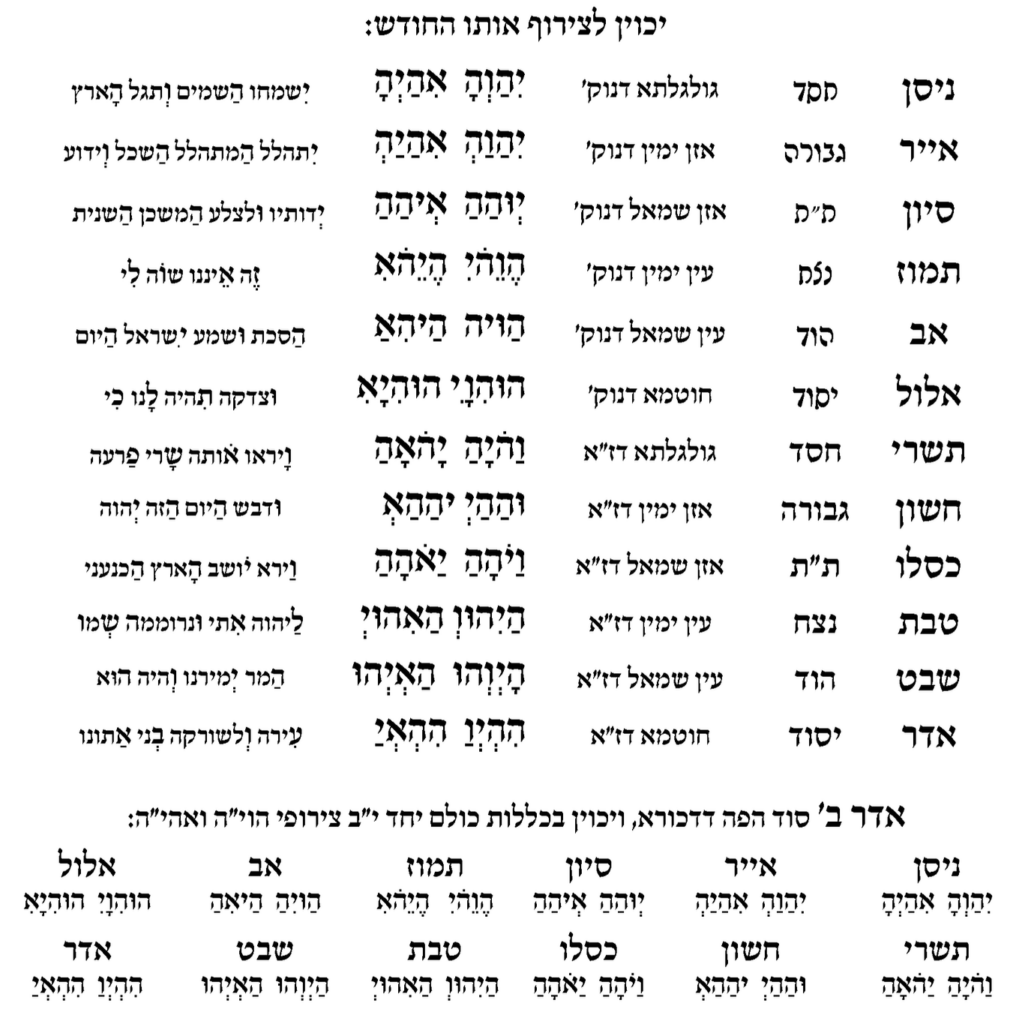
In Shaar HaKavanot, the Arizal explains that one may be mekaven these names throughout the specific month they correspond to, in order to draw down the blessings inherent in them.
The Ben Ish Chai, Rabbi Yosef Chaim of Baghdad, in his Ben Ish Chai (Shana Sheniya, Parashat Vayikra), elaborates on the practical customs of Rosh Chodesh. He teaches that Rosh Chodesh is a day of joy, that it carries a dimension of forgiveness, and that it is especially auspicious for prayer. He emphasizes the importance of the Ya’aleh VeYavo prayer, which invokes the remembrance of Israel, of Jerusalem, and of the Mashiach before the throne of glory.
“Rosh Chodesh is a day of joy and renewed closeness to God. It carries within it the power of forgiveness and renewal for all who seek it.”
(Ben Ish Chai, Shana Sheniya, Parashat Vayikra)
The Chida, Rabbi Chaim Yosef David Azulai, in his Moreh B’Etzba, lists among his recommended practices for Rosh Chodesh the recitation of special prayers and psalms, treating the day with a festive spirit, and using it as a time for introspection and spiritual accounting. He considered Rosh Chodesh a minor festival in its own right, with real spiritual potency for those who know how to access it.
Rosh Chodesh and the Gateway of Return
Rebbe Nachman of Breslov teaches that Rosh Chodesh is intimately connected to teshuvah (spiritual return). Just as the moon renews itself each month after a period of darkness, so too can a person renew themselves after a period of spiritual decline. The disappearance of the moon is not destruction. It is the necessary prelude to rebirth.
In Likutey Moharan (Torah 6), Rebbe Nachman discusses the concept of ratzo v’shov, running and returning, the back-and-forth movement between spiritual highs and lows that characterizes human experience. The rhythm of the moon embodies this teaching. There are times of fullness and illumination, and there are times when the light seems to vanish entirely. But the vanishing is itself the gateway to something new.
“A person must always look for the good points within themselves. Even when they have fallen, even when the light is hidden, it is only hidden so that it can return with greater force.”
(Rebbe Nachman, Likutey Moharan, Torah 282)
This teaching transforms the experience of spiritual darkness. Rather than seeing the dark of the moon as a time of despair, it becomes a time of potential. The Kabbalists understood that concealment is not absence. It is the womb of renewal. The very moment when the light seems gone is the moment when the seeds of the next illumination are being planted.
Rosh Chodesh and the Feminine Dimension
There is an ancient tradition, recorded in the Pirkei deRabbi Eliezer (Chapter 45), that Rosh Chodesh was given to the women of Israel as a reward for their refusal to participate in the sin of the golden calf. While the men surrendered their gold to build the idol, the women refused. In recognition of their faithfulness, they were granted Rosh Chodesh as a day of special spiritual significance.
The connection between women and Rosh Chodesh runs deeper than a historical reward. In Kabbalistic thought, the moon is the primary symbol of the feminine aspect of the Divine, the Shechinah. Women, who carry a natural correspondence to Malchut, are especially attuned to the spiritual energies of the new moon. The monthly renewal of the moon mirrors the feminine capacity for renewal, intuition, and receptivity.
The Ben Ish Chai notes that the custom for women to refrain from certain types of work on Rosh Chodesh is not merely a tradition but reflects a real spiritual reality: on this day, the feminine dimension of creation is elevated and honored. The light descending on Rosh Chodesh has a particular affinity with those who embody the quality of Malchut in the world.

The Half-Hallel: Praise in a State of Becoming
On Rosh Chodesh, we recite the Half-Hallel, omitting certain psalms that are included in the full Hallel of the festivals. The Arizal explains that this reflects the spiritual reality of Rosh Chodesh itself. The moon has only just begun to reappear. The Shechinah is in the process of being rebuilt but has not yet reached her fullness. The praise we offer corresponds to this state: genuine, heartfelt, but aware that the process of illumination is still underway.
Full Hallel is reserved for those moments when the light has reached its zenith, as on Sukkot, when the Shechinah is fully adorned. The Half-Hallel of Rosh Chodesh is the praise of beginnings, of a light that is growing but not yet complete. There is something deeply honest about this. It teaches us that we do not need to wait for perfection to offer praise. We can and should celebrate the first glimmer of renewal, trusting that it will grow.
Kiddush Levanah – Greeting the Shechinah
Closely related to Rosh Chodesh is the practice of Kiddush Levanah, the sanctification of the moon, performed when the new moon becomes visible in the sky. The Talmud (Sanhedrin 42a) states:
“Anyone who blesses the new moon in its proper time, it is as if they have greeted the Shechinah.”
(Talmud Bavli, Sanhedrin 42a)
This is because the renewal of the moon is the renewal of the Shechinah. When we stand under the night sky and recite the blessing, we are not simply marking an astronomical event. We are bearing witness to a cosmic process of restoration and aligning ourselves with it.
The Arizal teaches that the optimal time for Kiddush Levanah is on Motza’ei Shabbat (Saturday night), when we are still imbued with the additional soul of Shabbat and the spiritual elevation it brings. The combination of the sanctity of Shabbat’s departure and the renewal of the moon creates a uniquely powerful moment for connecting with the Shechinah.
Closing Reflections
Rosh Chodesh teaches us that renewal is not a one-time event but an ongoing rhythm built into the very structure of creation. The moon wanes and returns, the Shechinah conceals and reveals, and through it all, the promise of restoration remains unbroken.
The Kabbalists saw in the cycle of the moon the entire story of the world: a primordial wholeness, a necessary diminishment, a long process of gradual restoration, and a future moment when the moon will once again shine with the full brilliance of the sun. That future, they taught, is not only a cosmic event. It is something we help bring about through our awareness, our prayers, and our willingness to find light even in the darkest moments of the month.
Every Rosh Chodesh is an invitation. The gates are open. The Shechinah is being renewed. And we, who stand in the lower world and lift our eyes to the sky, have the extraordinary privilege of participating in that renewal.
Sources Cited
Primary Kabbalistic Sources
• Zohar, Parashat Bereishit (the diminishment of the moon and Malchut)
• Zohar, Parashat Bo (the commandment of Rosh Chodesh)
• Zohar, Parashat Pinchas (renewal of the Shechinah; the he-goat offering)
• Arizal, Pri Etz Chaim, Sha’ar Rosh Chodesh (spiritual dynamics of Rosh Chodesh)
• Rashash, Nahar Shalom (kavanot for Rosh Chodesh prayers)
• Ben Ish Chai, Shana Sheniya, Parashat Vayikra (customs and laws of Rosh Chodesh)
• Chida, Moreh B’Etzba (recommended practices for Rosh Chodesh)
• Rebbe Nachman, Likutey Moharan, Torah 6 and Torah 282
Talmudic Sources
• Talmud Bavli, Chulin 60b (diminishment of the moon; atonement for God)
• Talmud Bavli, Sanhedrin 42a (Kiddush Levanah as greeting the Shechinah)
Other Sources
• Pirkei deRabbi Eliezer, Chapter 45 (Rosh Chodesh and the women of Israel)
• Sefer Yetzirah (correspondence of months, letters, tribes, and senses)

3 Responses
בס”ד
La lumière cachée de Roch ‘Hodech – Les secrets kabbalistiques de la nouvelle lune
Roch ‘Hodech, la sanctification de la nouvelle lune, est l’un des moments les plus chargés spirituellement du calendrier juif.
C’est bien plus qu’une date sur un calendrier ou une formalité liturgique. Dans l’enseignement des kabbalistes, Roch ‘Hodech marque un renouvellement quantique, une renaissance mensuelle de la Chekhina elle-même, et une ouverture de nouveaux canaux de lumière divine dans le monde.
Le tout premier commandement donné au peuple juif en tant que nation, même avant la sortie d’Égypte, fut la sanctification de la nouvelle lune. Le verset dit : « Ce mois sera pour vous le commencement des mois » (Exode 12:2). Le Zohar (Parachat Bo) explique que ce commandement fut donné spécifiquement afin de donner à Israël la capacité de renouveler le temps lui-même, d’attirer la sainteté dans le cycle des mois et des saisons, et d’aligner le flux du monde inférieur avec les rythmes du monde supérieur.
Ce qui suit est une exploration des dimensions profondes de Roch ‘Hodech telles qu’elles sont comprises par les kabbalistes classiques : le Zohar, l’Ari zal, le Rashash, le Ben Ich ‘Haï et Rabbi Na’hman de Breslev.
Roch ‘Hodech Nouvelle Lune
La diminution de la lune
Pour comprendre Roch ‘Hodech, nous devons d’abord comprendre la lune. Le Talmud (Houlin 60b) rapporte un passage remarquable. Au quatrième jour de la création, la Torah déclare que Dieu fit « les deux grands luminaires » (Genèse 1:16). Mais le verset continue immédiatement : « le grand luminaire… et le petit luminaire ». Comment peuvent-ils être à la fois grands et petits ?
Le Talmud explique : le soleil et la lune furent à l’origine créés égaux en stature. La lune vint alors devant le Saint, béni soit-Il, et dit : « Maître de l’Univers, est-il possible que deux rois portent une seule couronne ? » Dieu répondit en disant à la lune de se diminuer.
« La lune dit devant le Saint, béni soit-Il : Maître de l’Univers, est-il possible que deux rois portent une seule couronne ? Il lui dit : Va et diminue-toi. »
(Talmud Bavli, Houlin 60b)
La lune protesta. Et dans l’un des passages les plus extraordinaires de toute la littérature talmudique, Dieu reconnut l’apparente injustice. Il ordonna à Israël d’apporter une offrande spéciale à Roch ‘Hodech comme une expiation, pour ainsi dire, pour la diminution de la lune :
« Le Saint, béni soit-Il, dit : Apportez une expiation pour Moi, car J’ai diminué la lune. »
(Talmud Bavli, Houlin 60b)
Pour le lecteur averti, le Talmud ne parle pas seulement d’astres, mais des Partsoufim de Zeir Anpin (également appelé le soleil) et de la Chekhina (également appelée la lune). Le Zohar (Béréchit) approfondit cet enseignement de façon incommensurable. La diminution de la lune n’est pas simplement un événement astronomique. Elle reflète une contraction primordiale de son Partsouf, une étape nécessaire dans le déploiement de la création qui introduisit séparation, hiérarchie, et la possibilité d’obscurité, de libre arbitre, de travail, de récompense et de punition.
Avant la diminution, Malkhout brillait avec la même radiance que Zeir Anpin (les six Séfirot de ‘Hessed jusqu’à Yessod, correspondant au soleil). Après cela, elle devint un réceptacle qui reçoit la lumière plutôt que de la générer. C’est la racine de tout exil, de toute nostalgie et de toute distance spirituelle dans le monde.
La lune comme Malkhout : une lumière qui reçoit
La correspondance entre la lune et Malkhout est l’un des enseignements les plus fondamentaux de la Kabbale. De même que la lune n’a pas de lumière propre et reflète celle du soleil, ainsi Malkhout reçoit toute son illumination des Séfirot supérieures.
Le Zohar utilise à maintes reprises la lune comme symbole principal de la Chekhina. Quand la lune est pleine, elle représente la Chekhina dans un état d’illumination complète, pleinement unie à Zeir Anpin. Quand la lune décroît et disparaît, cela signifie la dissimulation de la présence divine, le retrait de la Chekhina de la révélation manifeste.
« Quand la lune se renouvelle, la Chekhina se renouvelle. Et quand la Chekhina se renouvelle, la bénédiction descend dans tous les mondes inférieurs. »
(Zohar, Parachat Pin’has)
C’est pourquoi la croissance de la lune, depuis sa disparition à la fin du mois jusqu’à sa réapparition progressive, est plus qu’un phénomène physique. Elle reflète le processus même par lequel la Chekhina est restaurée, étape par étape, de la dissimulation à la radiance. Chaque mois, ces événements se rejouent, offrant à ceux qui le comprennent l’occasion de participer à la restauration de la lumière divine.
Tout cela éclaire pourquoi le roi Salomon termina et inaugura le Saint Temple précisément à Yom Kippour, au moment où la lune est dans toute sa gloire. Cela représenta probablement l’apogée du royaume juif, et au lieu de devoir jeûner, les Juifs célébrèrent par des festins.
Roch ‘Hodech : le moment du renouveau
L’Ari zal, Rabbi Yits’hak Louria, consacra de nombreux enseignements aux dynamiques spirituelles de Roch ‘Hodech. Dans Pri Ets ‘Haïm (Cha’ar Roch ‘Hodech), il explique que le moment de la nouvelle lune, le molad, représente le point où Malkhout commence à recevoir une nouvelle lumière après une période de dissimulation presque totale.
À la fin de chaque mois lunaire, la lune disparaît complètement. Cela correspond à un état où Malkhout est descendue à son point le plus bas et où sa lumière est cachée. À ce moment, Malkhout retourne, pour ainsi dire, dans le sein de Bina (Compréhension), la Mère suprême. Là, elle est reconstituée, renouvelée et remplie d’un nouveau potentiel spirituel.
« À Roch ‘Hodech, Malkhout monte vers Bina et y est renouvelée, recevant de nouvelles lumières et de nouveaux vêtements pour le mois à venir. »
(Ari zal, Pri Ets ‘Haïm, Cha’ar Roch ‘Hodech)
C’est un processus de véritable renaissance. La Chekhina ne reprend pas simplement son état précédent. Elle est reconstruite depuis le commencement, recevant chaque mois une configuration unique de lumière correspondant au caractère spirituel particulier de ce mois. C’est pourquoi chaque mois possède son énergie propre, sa lettre, sa tribu et son sens, comme exposé dans le Séfer Yetsira.
Le bouc de Roch ‘Hodech : un sacrifice unique
L’offrande de Moussaf de Roch ‘Hodech, décrite dans Nombres 28:15, contient un élément frappant : un bouc (sé’ir izim) offert comme sacrifice expiatoire. Les mots exacts de la Torah sont : « et un bouc comme sacrifice expiatoire pour Hachem » (Nombres 28:15). L’expression « pour Hachem » est inhabituelle. Les autres sacrifices expiatoires sont simplement décrits comme tels. Celui-ci est spécifié comme étant pour Dieu.
Comme nous l’avons vu, le Talmud (Houlin 60b) interprète cela comme signifiant que Dieu Lui-même, pour ainsi dire, demande une expiation pour avoir diminué la lune. Les implications sont stupéfiantes. Cela signifie qu’inscrite dans la structure même de la création se trouve une reconnaissance du Créateur que le processus de différenciation, la contraction nécessaire qui permit au monde d’exister, impliqua une sorte de perte. L’offrande mensuelle de Roch ‘Hodech est une reconnaissance divine de cette perte et une promesse de sa restauration future.
Le Zohar (Parachat Pin’has) ajoute que le bouc de Roch ‘Hodech sert à apaiser les forces de jugement strict (Dinim) et à les empêcher de tirer leur subsistance du côté saint. En donnant à la Sitra A’hra (l’autre côté) sa part assignée par cette offrande, les forces de sainteté sont libérées pour agir sans interférence. C’est l’un des secrets les plus profonds du service sacrificiel : contenir le jugement afin que la miséricorde puisse s’écouler sans obstacle.
Les douze mois et les permutations du Nom divin
Dans les écrits de l’Ari zal, nous trouvons que chacun des douze mois correspond à l’une des douze permutations des lettres du Tétragramme (Y-H-V-H). Ces permutations définissent le caractère spirituel de chaque mois, déterminant quels types d’énergie divine sont accessibles et quels types de travail spirituel sont les plus efficaces.
Par exemple, le mois de Nissan, le mois de la rédemption, correspond à la permutation Y-H-V-H dans son ordre standard, représentant le flux complet et direct de miséricorde divine. Le mois de Tamouz, associé à la brèche des murailles de Jérusalem, correspond à une permutation reflétant un jugement accru. Chaque mois ouvre une porte unique dans les cieux.
Roch ‘Hodech Noms sacrés
Dans Cha’ar HaKavanot, l’Ari zal explique qu’on peut avoir ces Noms à l’esprit durant le mois qui leur correspond afin d’attirer les bénédictions qu’ils contiennent.
Le Ben Ich ‘Haï, Rabbi Yossef ‘Haïm de Bagdad, dans son Ben Ich ‘Haï (Chana Chéniya, Parachat Vayikra), développe les coutumes pratiques de Roch ‘Hodech. Il enseigne que Roch ‘Hodech est un jour de joie, qu’il porte une dimension de pardon, et qu’il est particulièrement propice à la prière. Il souligne l’importance de la prière Ya’alé Veyavo, qui invoque le souvenir d’Israël, de Jérusalem et du Machia’h devant le trône de gloire.
« Roch ‘Hodech est un jour de joie et de proximité renouvelée avec Dieu. Il porte en lui la force du pardon et du renouveau pour tous ceux qui le recherchent. »
(Ben Ich ‘Haï, Chana Chéniya, Parachat Vayikra)
Le ‘Hida, Rabbi ‘Haïm Yossef David Azulai, dans son Moreh Be’etsba, énumère parmi ses pratiques recommandées pour Roch ‘Hodech la récitation de prières et psaumes spéciaux, le fait de traiter le jour avec un esprit festif, et de l’utiliser comme moment d’introspection et d’examen spirituel. Il considérait Roch ‘Hodech comme une petite fête à part entière, dotée d’une véritable puissance spirituelle pour ceux qui savent y accéder.
Roch ‘Hodech et la porte du retour
Rabbi Na’hman de Breslev enseigne que Roch ‘Hodech est intimement lié à la téchouva (retour spirituel). De même que la lune se renouvelle chaque mois après une période d’obscurité, ainsi une personne peut se renouveler après une période de déclin spirituel. La disparition de la lune n’est pas une destruction. C’est le prélude nécessaire à la renaissance.
Dans Likouté Moharan (Torah 6), Rabbi Na’hman parle du concept de ratzo véchov, courir et revenir, le mouvement d’aller-retour entre les hauts et les bas spirituels qui caractérise l’expérience humaine. Le rythme de la lune incarne cet enseignement. Il y a des moments de plénitude et d’illumination, et des moments où la lumière semble disparaître entièrement. Mais cette disparition est elle-même la porte vers quelque chose de nouveau.
« Une personne doit toujours chercher les bons points en elle-même. Même lorsqu’elle est tombée, même lorsque la lumière est cachée, elle n’est cachée que pour revenir avec plus de force. »
(Rabbi Na’hman, Likouté Moharan, Torah 282)
Cet enseignement transforme l’expérience de l’obscurité spirituelle. Au lieu de voir l’obscurité de la lune comme un temps de désespoir, elle devient un temps de potentiel. Les kabbalistes comprenaient que la dissimulation n’est pas une absence. C’est le sein du renouveau. Le moment même où la lumière semble partie est le moment où les graines de la prochaine illumination sont plantées.
Roch ‘Hodech et la dimension féminine
Il existe une tradition ancienne, rapportée dans Pirkei deRabbi Eliezer (chapitre 45), selon laquelle Roch ‘Hodech fut donné aux femmes d’Israël comme récompense pour leur refus de participer au péché du veau d’or. Tandis que les hommes livrèrent leur or pour fabriquer l’idole, les femmes refusèrent. En reconnaissance de leur fidélité, elles reçurent Roch ‘Hodech comme jour de signification spirituelle particulière.
Le lien entre les femmes et Roch ‘Hodech va plus loin qu’une récompense historique. Dans la pensée kabbalistique, la lune est le symbole principal de l’aspect féminin du Divin, la Chekhina. Les femmes, qui portent une correspondance naturelle avec Malkhout, sont particulièrement sensibles aux énergies spirituelles de la nouvelle lune. Le renouvellement mensuel de la lune reflète la capacité féminine de renouvellement, d’intuition et de réceptivité.
Le Ben Ich ‘Haï note que la coutume pour les femmes de s’abstenir de certains travaux à Roch ‘Hodech n’est pas seulement une tradition mais reflète une réalité spirituelle : en ce jour, la dimension féminine de la création est élevée et honorée. La lumière qui descend à Roch ‘Hodech possède une affinité particulière avec ceux qui incarnent la qualité de Malkhout dans le monde.
Le demi-Hallel : louange dans un état de devenir
À Roch ‘Hodech, nous récitons le demi-Hallel, en omettant certains psaumes inclus dans le Hallel complet des fêtes. L’Ari zal explique que cela reflète la réalité spirituelle de Roch ‘Hodech lui-même. La lune vient à peine de réapparaître. La Chekhina est en cours de reconstruction mais n’a pas encore atteint sa plénitude. La louange que nous offrons correspond à cet état : sincère, profonde, mais consciente que le processus d’illumination est encore en marche.
Le Hallel complet est réservé aux moments où la lumière atteint son zénith, comme à Souccot, lorsque la Chekhina est pleinement parée. Le demi-Hallel de Roch ‘Hodech est la louange des commencements, d’une lumière qui grandit mais n’est pas encore complète. Il y a quelque chose de profondément honnête en cela. Cela nous enseigne que nous n’avons pas besoin d’attendre la perfection pour louer. Nous pouvons et devons célébrer la première lueur du renouveau, en ayant confiance qu’elle grandira.
Kidouch Levana – Saluer la Chekhina
Étroitement liée à Roch ‘Hodech se trouve la pratique de Kidouch Levana, la sanctification de la lune, accomplie lorsque la nouvelle lune devient visible dans le ciel. Le Talmud (Sanhedrin 42a) déclare :
« Quiconque bénit la nouvelle lune en son temps, c’est comme s’il avait accueilli la Chekhina. »
(Talmud Bavli, Sanhedrin 42a)
Cela parce que le renouvellement de la lune est le renouvellement de la Chekhina. Lorsque nous nous tenons sous le ciel nocturne et récitons la bénédiction, nous ne faisons pas simplement remarquer un événement astronomique. Nous témoignons d’un processus cosmique de restauration et nous nous alignons avec lui.
L’Ari zal enseigne que le moment optimal pour Kidouch Levana est Motzaé Chabbat (samedi soir), lorsque nous sommes encore imprégnés de l’âme supplémentaire du Chabbat et de l’élévation spirituelle qu’elle apporte. La combinaison de la sainteté du départ du Chabbat et du renouvellement de la lune crée un moment particulièrement puissant pour se connecter à la Chekhina.
Réflexions finales
Roch ‘Hodech nous enseigne que le renouveau n’est pas un événement unique mais un rythme continu inscrit dans la structure même de la création. La lune décroît et revient, la Chekhina se cache et se révèle, et à travers tout cela, la promesse de restauration demeure intacte.
Les kabbalistes voyaient dans le cycle de la lune toute l’histoire du monde : une plénitude primordiale, une diminution nécessaire, un long processus de restauration progressive, et un futur moment où la lune brillera de nouveau avec toute la splendeur du soleil. Cet avenir, enseignaient-ils, n’est pas seulement un événement cosmique. C’est quelque chose que nous aidons à accomplir par notre conscience, nos prières et notre volonté de trouver la lumière même dans les moments les plus sombres du mois.
Chaque Roch ‘Hodech est une invitation. Les portes sont ouvertes. La Chekhina est en train d’être renouvelée. Et nous, qui nous tenons dans le monde inférieur et levons les yeux vers le ciel, avons le privilège extraordinaire de participer à ce renouveau.
Sources citées
Sources kabbalistiques principales
• Zohar, Parachat Béréchit (la diminution de la lune et Malkhout)
• Zohar, Parachat Bo (le commandement de Roch ‘Hodech)
• Zohar, Parachat Pin’has (renouvellement de la Chekhina ; offrande du bouc)
• Ari zal, Pri Ets ‘Haïm, Cha’ar Roch ‘Hodech (dynamiques spirituelles de Roch ‘Hodech)
• Rashash, Nahar Chalom (kavanot pour les prières de Roch ‘Hodech)
• Ben Ich ‘Haï, Chana Chéniya, Parachat Vayikra (coutumes et lois de Roch ‘Hodech)
• ‘Hida, Moreh Be’etsba (pratiques recommandées pour Roch ‘Hodech)
• Rabbi Na’hman, Likouté Moharan, Torah 6 et Torah 282
Sources talmudiques
• Talmud Bavli, Houlin 60b (diminution de la lune ; expiation pour Dieu)
• Talmud Bavli, Sanhedrin 42a (Kidouch Levana comme accueil de la Chekhina)
Autres sources
• Pirkei deRabbi Eliezer, chapitre 45 (Roch ‘Hodech et les femmes d’Israël)
• Séfer Yetsira (correspondance des mois, lettres, tribus et sens)
In Portuguese
A luz oculta de Rosh Chodesh – Segredos cabalísticos da lua nova
Rosh Chodesh, a santificação da lua nova, é um dos momentos mais carregados espiritualmente no calendário judaico.
É muito mais do que uma data no calendário ou uma formalidade litúrgica. Nos ensinamentos dos cabalistas, Rosh Chodesh marca uma renovação quântica, um renascimento mensal da própria Shechiná, e uma abertura de novos canais de luz Divina no mundo.
O primeiro mandamento dado ao povo judeu como nação, mesmo antes do Êxodo do Egito, foi a santificação da lua nova. O versículo diz: “Este mês será para vós o princípio dos meses” (Êxodo 12:2). O Zohar (Parashat Bo) explica que esse mandamento foi dado especificamente para capacitar Israel com a habilidade de renovar o próprio tempo, atrair santidade para o ciclo dos meses e das estações, e alinhar o fluxo do mundo inferior com os ritmos do superior.
O que segue é uma exploração das dimensões mais profundas de Rosh Chodesh conforme compreendidas pelos cabalistas clássicos: o Zohar, o Arizal, o Rashash, o Ben Ish Chai e o Rebe Nachman de Breslov.
Rosh Chodesh Lua Nova
A diminuição da lua
Para compreender Rosh Chodesh, devemos primeiro compreender a lua. O Talmud (Chulin 60b) registra uma passagem notável. No quarto dia da criação, a Torá declara que Deus fez “os dois grandes luminares” (Gênesis 1:16). Mas o versículo continua imediatamente: “o grande luminar… e o pequeno luminar”. Como podem ser ambos grandes e pequenos?
O Talmud explica: o sol e a lua foram originalmente criados iguais em estatura. A lua então veio diante do Santo, bendito seja Ele, e disse: “Mestre do Universo, é possível que dois reis compartilhem uma única coroa?” Deus respondeu dizendo à lua que se diminuísse.
“A lua disse diante do Santo, bendito seja Ele: Mestre do Universo, é possível que dois reis compartilhem uma coroa? Ele lhe disse: Vai e diminui-te.”
(Talmud Bavli, Chulin 60b)
A lua protestou. E em uma das passagens mais extraordinárias de toda a literatura talmúdica, Deus reconheceu a aparente injustiça. Ele ordenou a Israel que trouxesse uma oferta especial em Rosh Chodesh como expiação, por assim dizer, pela diminuição da lua:
“O Santo, bendito seja Ele, disse: Trazei uma expiação por Mim, pois Eu diminui a lua.”
(Talmud Bavli, Chulin 60b)
Para o leitor perspicaz, o Talmud não está falando apenas de corpos celestes, mas dos Partzufim de Zeir Anpin (também conhecido como o sol) e da Shekhina (também conhecida como a lua). O Zohar (Bereishit) aprofunda esse ensinamento imensuravelmente. A diminuição da lua não é apenas um evento astronômico. Ela reflete uma contração primordial de seu Partzuf, uma etapa necessária no desdobramento da criação que introduziu separação, hierarquia e a possibilidade de escuridão, livre-arbítrio, trabalho, recompensa e punição.
Antes da diminuição, Malchut brilhava com a mesma radiância que Zeir Anpin (as seis Sefirot de Chesed até Yesod, correspondentes ao sol). Depois, ela tornou-se um recipiente que recebe luz em vez de gerá-la. Esta é a raiz de todo exílio, todo anseio e toda distância espiritual no mundo.
A lua como Malchut: uma luz que recebe
A correspondência entre a lua e Malchut é um dos ensinamentos mais fundamentais da Cabalá. Assim como a lua não possui luz própria e reflete a luz do sol, assim Malchut recebe toda a sua iluminação das Sefirot superiores.
O Zohar usa repetidamente a lua como seu símbolo principal da Shechiná. Quando a lua está cheia, ela representa a Shechiná em um estado de iluminação completa, plenamente unida a Zeir Anpin. Quando a lua mingua e desaparece, isso significa a ocultação da presença Divina, a retirada da Shechiná da revelação aberta.
“Quando a lua se renova, a Shechiná se renova. E quando a Shechiná se renova, a bênção desce a todos os mundos inferiores.”
(Zohar, Parashat Pinchas)
É por isso que o crescimento da lua, desde o seu desaparecimento no fim do mês até a sua reaparição gradual, é mais do que um fenômeno físico. Ele espelha o próprio processo pelo qual a Shechiná é restaurada, passo a passo, da ocultação à radiância. A cada mês, esses eventos se repetem, oferecendo àqueles que o compreendem uma oportunidade de participar da restauração da luz Divina.
Tudo isso lança luz sobre por que o rei Salomão terminou e inaugurou o Santo Templo especificamente em Yom Kippur, no momento em que a lua está em sua plena glória. Isso provavelmente representou o auge do Reino Judaico, e em vez de terem de jejuar, os judeus celebraram com banquetes.
Rosh Chodesh: o momento da renovação
O Arizal, Rabino Yitzchak Luria, dedicou extensos ensinamentos à dinâmica espiritual de Rosh Chodesh. Em Pri Etz Chaim (Sha’ar Rosh Chodesh), ele explica que o momento da lua nova, o molad, representa o ponto em que Malchut começa a receber nova luz após um período de ocultação quase total.
No fim de cada mês lunar, a lua desaparece completamente. Isso corresponde a um estado em que Malchut desceu ao seu ponto mais baixo e sua luz está oculta. Nesse ponto, Malchut retorna, por assim dizer, ao ventre de Binah (Entendimento), a Mãe suprema. Ali ela é reconstituída, renovada e preenchida com novo potencial espiritual.
“Em Rosh Chodesh, Malchut ascende a Binah e ali é renovada, recebendo novas luzes e novas vestes para o mês que se aproxima.”
(Arizal, Pri Etz Chaim, Sha’ar Rosh Chodesh)
Este é um processo de verdadeiro renascimento. A Shechiná não apenas retoma seu estado anterior. Ela é reconstruída desde o início, recebendo a cada mês uma configuração única de luz que corresponde ao caráter espiritual específico daquele mês. É por isso que cada mês possui sua própria energia distinta, sua própria letra, sua própria tribo e seu próprio sentido, como descrito no Sefer Yetzirah.
O bode de Rosh Chodesh: um sacrifício diferente de todos os outros
A oferta de Musaf de Rosh Chodesh, conforme descrita em Números 28:15, inclui um elemento marcante: um bode (se’ir izim) trazido como oferta pelo pecado. As palavras exatas da Torá são: “e um bode como oferta pelo pecado para Hashem” (Números 28:15). A expressão “para Hashem” é incomum. Outras ofertas pelo pecado são descritas simplesmente como ofertas pelo pecado. Esta é especificada como sendo para Deus.
Como vimos, o Talmud (Chulin 60b) interpreta isso como significando que o próprio Deus, por assim dizer, pede expiação por ter diminuído a lua. As implicações disso são impressionantes. Significa que está incorporado na própria estrutura da criação um reconhecimento do Criador de que o processo de diferenciação, a contração necessária que permitiu que o mundo existisse, envolveu uma espécie de perda. A oferta mensal de Rosh Chodesh é um reconhecimento Divino dessa perda e uma promessa de sua eventual restauração.
O Zohar (Parashat Pinchas) acrescenta que o bode de Rosh Chodesh serve para apaziguar as forças de julgamento rigoroso (Dinim) e impedir que elas extraiam sustento do lado sagrado. Ao dar à Sitra Achra (o outro lado) a sua porção designada por meio dessa oferta, as forças de santidade ficam livres para operar sem interferência. Este é um dos segredos mais profundos do serviço sacrificial: conter o julgamento para que a misericórdia possa fluir sem obstrução.
Os doze meses e as permutações do Nome Divino
Nos escritos do Arizal, encontramos que cada um dos doze meses corresponde a uma das doze permutações das letras do Tetragrama (Y-H-V-H). Essas permutações definem o caráter espiritual de cada mês, determinando quais tipos de energia Divina são acessíveis e quais tipos de trabalho espiritual são mais eficazes.
Por exemplo, o mês de Nissan, o mês da redenção, corresponde à permutação Y-H-V-H em sua ordem padrão, representando o fluxo pleno e direto de misericórdia Divina. O mês de Tammuz, associado à brecha dos muros de Jerusalém, corresponde a uma permutação que reflete julgamento intensificado. Cada mês abre um portal único nos céus.
Rosh Chodesh Nomes Sagrados
Em Shaar HaKavanot, o Arizal explica que se pode ter essas combinações em mente ao longo do mês correspondente a elas, a fim de atrair as bênçãos inerentes nelas.
O Ben Ish Chai, Rabino Yosef Chaim de Bagdá, em seu Ben Ish Chai (Shana Sheniya, Parashat Vayikra), elabora sobre os costumes práticos de Rosh Chodesh. Ele ensina que Rosh Chodesh é um dia de alegria, que possui uma dimensão de perdão e que é especialmente propício para a oração. Ele enfatiza a importância da oração Ya’aleh VeYavo, que invoca a lembrança de Israel, de Jerusalém e do Mashiach diante do trono de glória.
“Rosh Chodesh é um dia de alegria e proximidade renovada com Deus. Ele contém dentro de si o poder do perdão e da renovação para todos os que o buscam.”
(Ben Ish Chai, Shana Sheniya, Parashat Vayikra)
O Chida, Rabino Chaim Yosef David Azulai, em seu Moreh B’Etzba, lista entre suas práticas recomendadas para Rosh Chodesh a recitação de orações e salmos especiais, tratar o dia com espírito festivo e usá-lo como um tempo de introspecção e balanço espiritual. Ele considerava Rosh Chodesh um pequeno festival por direito próprio, com verdadeira potência espiritual para aqueles que sabem acessá-la.
Rosh Chodesh e o portal do retorno
O Rebe Nachman de Breslov ensina que Rosh Chodesh está intimamente ligado à teshuvá (retorno espiritual). Assim como a lua se renova a cada mês após um período de escuridão, assim também uma pessoa pode se renovar após um período de declínio espiritual. O desaparecimento da lua não é destruição. É o prelúdio necessário para o renascimento.
Em Likutei Moharan (Torá 6), Rebe Nachman discute o conceito de ratzo v’shov, correr e retornar, o movimento de vai-e-vem entre altos e baixos espirituais que caracteriza a experiência humana. O ritmo da lua incorpora esse ensinamento. Há tempos de plenitude e iluminação, e há tempos em que a luz parece desaparecer completamente. Mas o desaparecimento é ele próprio o portal para algo novo.
“Uma pessoa deve sempre procurar os bons pontos dentro de si. Mesmo quando caiu, mesmo quando a luz está oculta, ela está oculta apenas para que possa retornar com maior força.”
(Rebe Nachman, Likutei Moharan, Torá 282)
Esse ensinamento transforma a experiência da escuridão espiritual. Em vez de ver a escuridão da lua como um tempo de desespero, ela se torna um tempo de potencial. Os cabalistas entendiam que ocultação não é ausência. É o ventre da renovação. O próprio momento em que a luz parece ter desaparecido é o momento em que as sementes da próxima iluminação estão sendo plantadas.
Rosh Chodesh e a dimensão feminina
Há uma antiga tradição, registrada em Pirkei deRabbi Eliezer (capítulo 45), de que Rosh Chodesh foi dado às mulheres de Israel como recompensa por sua recusa em participar do pecado do bezerro de ouro. Enquanto os homens entregaram seu ouro para construir o ídolo, as mulheres recusaram. Em reconhecimento à sua fidelidade, elas receberam Rosh Chodesh como um dia de especial significado espiritual.
A conexão entre as mulheres e Rosh Chodesh vai mais fundo do que uma recompensa histórica. No pensamento cabalístico, a lua é o símbolo principal do aspecto feminino do Divino, a Shechiná. As mulheres, que possuem uma correspondência natural com Malchut, estão especialmente sintonizadas com as energias espirituais da lua nova. A renovação mensal da lua espelha a capacidade feminina de renovação, intuição e receptividade.
O Ben Ish Chai observa que o costume das mulheres de se absterem de certos tipos de trabalho em Rosh Chodesh não é meramente uma tradição, mas reflete uma realidade espiritual real: nesse dia, a dimensão feminina da criação é elevada e honrada. A luz que desce em Rosh Chodesh possui uma afinidade particular com aqueles que incorporam a qualidade de Malchut no mundo.
O meio-Hallel: louvor em estado de tornar-se
Em Rosh Chodesh recitamos o meio-Hallel, omitindo certos salmos que estão incluídos no Hallel completo das festas. O Arizal explica que isso reflete a própria realidade espiritual de Rosh Chodesh. A lua apenas começou a reaparecer. A Shechiná está em processo de reconstrução, mas ainda não alcançou sua plenitude. O louvor que oferecemos corresponde a esse estado: genuíno, sincero, mas consciente de que o processo de iluminação ainda está em andamento.
O Hallel completo é reservado para momentos em que a luz alcançou seu ápice, como em Sucot, quando a Shechiná está plenamente adornada. O meio-Hallel de Rosh Chodesh é o louvor dos começos, de uma luz que está crescendo mas ainda não está completa. Há algo profundamente honesto nisso. Ensina-nos que não precisamos esperar pela perfeição para louvar. Podemos e devemos celebrar o primeiro vislumbre de renovação, confiando que ele crescerá.
Kidush Levanah – Saudando a Shechiná
Intimamente relacionado a Rosh Chodesh está o costume de Kidush Levanah, a santificação da lua, realizada quando a lua nova se torna visível no céu. O Talmud (Sanhedrin 42a) declara:
“Qualquer pessoa que abençoa a lua nova em seu tempo é como se tivesse saudado a Shechiná.”
(Talmud Bavli, Sanhedrin 42a)
Isso porque a renovação da lua é a renovação da Shechiná. Quando ficamos sob o céu noturno e recitamos a bênção, não estamos apenas marcando um evento astronômico. Estamos testemunhando um processo cósmico de restauração e nos alinhando com ele.
O Arizal ensina que o momento ideal para Kidush Levanah é em Motzaei Shabat (sábado à noite), quando ainda estamos impregnados com a alma adicional do Shabat e a elevação espiritual que ela traz. A combinação da santidade da partida do Shabat e da renovação da lua cria um momento singularmente poderoso para conectar-se com a Shechiná.
Reflexões finais
Rosh Chodesh ensina que a renovação não é um evento único, mas um ritmo contínuo incorporado na própria estrutura da criação. A lua mingua e retorna, a Shechiná oculta e revela, e através de tudo isso a promessa de restauração permanece intacta.
Os cabalistas viram no ciclo da lua toda a história do mundo: uma plenitude primordial, uma diminuição necessária, um longo processo de restauração gradual e um momento futuro em que a lua voltará a brilhar com todo o esplendor do sol. Esse futuro, ensinaram, não é apenas um evento cósmico. É algo que ajudamos a trazer à existência por meio de nossa consciência, nossas orações e nossa disposição de encontrar luz mesmo nos momentos mais escuros do mês.
Cada Rosh Chodesh é um convite. Os portões estão abertos. A Shechiná está sendo renovada. E nós, que estamos no mundo inferior e erguemos nossos olhos ao céu, temos o extraordinário privilégio de participar dessa renovação.
Fontes citadas
Fontes cabalísticas primárias
• Zohar, Parashat Bereishit (a diminuição da lua e Malchut)
• Zohar, Parashat Bo (o mandamento de Rosh Chodesh)
• Zohar, Parashat Pinchas (renovação da Shechiná; a oferta do bode)
• Arizal, Pri Etz Chaim, Sha’ar Rosh Chodesh (dinâmicas espirituais de Rosh Chodesh)
• Rashash, Nahar Shalom (kavanot para as orações de Rosh Chodesh)
• Ben Ish Chai, Shana Sheniya, Parashat Vayikra (costumes e leis de Rosh Chodesh)
• Chida, Moreh B’Etzba (práticas recomendadas para Rosh Chodesh)
• Rebe Nachman, Likutei Moharan, Torá 6 e Torá 282
Fontes talmúdicas
• Talmud Bavli, Chulin 60b (diminuição da lua; expiação por Deus)
• Talmud Bavli, Sanhedrin 42a (Kidush Levanah como saudação à Shechiná)
Outras fontes
• Pirkei deRabbi Eliezer, capítulo 45 (Rosh Chodesh e as mulheres de Israel)
• Sefer Yetzirah (correspondência dos meses, letras, tribos e sentidos)
In Kazakh
Рош Ходештің жасырын нұры – Жаңа айдың каббалистік құпиялары
Рош Ходеш, жаңа айды қасиеттеу, еврей күнтізбесіндегі рухани қуаты ең жоғары сәттердің бірі.
Бұл күнтізбедегі жай ғана күн немесе литургиялық формалдық емес. Каббалистердің ілімдерінде Рош Ходеш кванттық жаңаруды, Шехинаның ай сайынғы қайта тууын және әлемге Құдайлық нұрдың жаңа арналарының ашылуын білдіреді.
Еврей халқына ұлт ретінде берілген ең алғашқы өсиет, тіпті Мысырдан шығудан бұрын, жаңа айды қасиеттеу болды. Аятта былай делінген: «Бұл ай сендер үшін айлардың басы болады» (Мысырдан шығу 12:2). Зоһар (Бо парашасы) бұл өсиет арнайы Израильге уақыттың өзін жаңарту қабілетін беру үшін, айлар мен маусымдардың айналымына қасиеттілік тарту үшін және төменгі әлемнің ағынын жоғарғы әлемнің ырғақтарымен сәйкестендіру үшін берілгенін түсіндіреді.
Төменде классикалық каббалистер – Зоһар, Аризал, Рашаш, Бен Иш Хай және Бресловтық Рабби Нахман – түсіндірген Рош Ходештің терең өлшемдерінің зерттелуі берілген.
Рош Ходеш Жаңа Ай
Айдың кішіреюі
Рош Ходешті түсіну үшін алдымен айды түсіну керек. Талмуд (Хулин 60b) таңғаларлық бір үзіндіні келтіреді. Жаратылыстың төртінші күнінде Таурат Құдай «екі үлкен шамшырақты» жаратқанын айтады (Жаратылыс 1:16). Бірақ аят бірден жалғасады: «үлкен шамшырақ… және кіші шамшырақ». Олар қалайша әрі үлкен, әрі кіші бола алады?
Талмуд түсіндіреді: күн мен ай бастапқыда дәрежесі жағынан тең жаратылған. Сонда ай Қасиетті, Ол жарылқанған, алдында келіп: «Әлемнің Иесі, екі патша бір тәжді бөлісе ала ма?» деді. Құдай айға өзін кішірейтуді бұйырды.
«Ай Қасиетті, Ол жарылқанған, алдында айтты: Әлемнің Иесі, екі патша бір тәжді бөлісе ала ма? Ол оған айтты: Бар да өзіңді кішірейт.»
(Вавилондық Талмуд, Хулин 60b)
Ай қарсы шықты. Ал бүкіл талмуд әдебиетіндегі ең ғажайып үзінділердің бірінде Құдай көрінген әділетсіздікті мойындады. Ол Израильге Рош Ходеште арнайы құрбандық әкелуді бұйырды, бейнебір айдың кішіреюі үшін өтеу ретінде:
«Қасиетті, Ол жарылқанған, айтты: Маған өтеу әкеліңдер, өйткені Мен айды кішірейттім.»
(Вавилондық Талмуд, Хулин 60b)
Түсінгіш оқырман үшін Талмуд тек аспан денелері туралы ғана емес, Зеир Анпиннің (күн деп те аталады) және Шехинаның (ай деп те аталады) Парцуфимдері туралы айтып отыр. Зоһар (Берешит) бұл ілімді өлшеусіз тереңдетеді. Айдың кішіреюі жай астрономиялық құбылыс емес. Ол оның Парцуфының бастапқы қысқаруын бейнелейді – жаратылыстың ашылуындағы қажетті кезең, ол бөлінуді, иерархияны және қараңғылықтың, еркін еріктің, еңбектің, сый мен жазаның мүмкіндігін енгізді.
Кішіреюге дейін Малхут Зеир Анпинмен бірдей нұрмен жарқырады (Хеседтен Йесодқа дейінгі алты Сефирот, олар күнге сәйкес келеді). Одан кейін ол жарық шығаратын емес, қабылдайтын ыдысқа айналды. Бұл әлемдегі барлық жер аударылудың, барлық сағыныштың және барлық рухани қашықтықтың түбірі.
Ай Малхут ретінде: қабылдайтын нұр
Ай мен Малхут арасындағы сәйкестік – Каббаладағы ең негізгі ілімдердің бірі. Айдың өз нұры болмай, күннің нұрын шағылыстыратыны сияқты, Малхут та барлық жарығын жоғарғы Сефироттан алады.
Зоһар айды Шехинаның негізгі символы ретінде қайта-қайта қолданады. Ай толғанда, ол Шехинаның толық жарық күйін, Зеир Анпинмен толық бірігуін білдіреді. Ай кеміп жоғалғанда, бұл Құдайлық қатысудың жасырылуын, Шехинаның ашық көріністен шегінуін білдіреді.
«Ай жаңарғанда, Шехина жаңарады. Ал Шехина жаңарғанда, береке барлық төменгі әлемдерге түседі.»
(Зоһар, Пинхас парашасы)
Сондықтан айдың өсуі, ай соңында жоғалып, біртіндеп қайта көрінуі, жай физикалық құбылыс емес. Ол Шехинаның жасырынудан нұрға дейін біртіндеп қалпына келу үдерісін бейнелейді. Әр ай сайын бұл оқиғалар қайталанып, оны түсінетіндерге Құдайлық нұрдың қалпына келуіне қатысу мүмкіндігін береді.
Бұл сондай-ақ патша Сүлейменнің Қасиетті Ғибадатхананы дәл Йом Киппурда, ай толық даңқында тұрған кезде аяқтап, ашқанының мәнін түсіндіреді. Бұл еврей патшалығының шыңы болған болуы мүмкін, және ораза ұстаудың орнына еврейлер той жасап тойлаған.
Рош Ходеш: жаңару сәті
Аризал, Рабби Ицхак Лурия, Рош Ходештің рухани динамикасына кең ілімдер арнады. «При Эц Хаим» (Рош Ходеш қақпасы) еңбегінде ол жаңа ай сәті – молад – Малхуттың толыққа жуық жасырынудан кейін жаңа нұр ала бастайтын нүктені білдіретінін түсіндіреді.
Әр айдың соңында ай толық жоғалады. Бұл Малхут ең төмен нүктесіне түсіп, оның нұры жасырылған күйге сәйкес келеді. Осы сәтте Малхут, бейнебір, жоғарғы Ана – Бинаға (Түсінік) қайта оралады. Сол жерде ол қайта құрылып, жаңарып, жаңа рухани әлеуетпен толтырылады.
«Рош Ходеште Малхут Бинаға көтеріледі және сол жерде жаңарып, алдағы ай үшін жаңа нұрлар мен жаңа киімдер алады.»
(Аризал, При Эц Хаим, Рош Ходеш қақпасы)
Бұл – шынайы қайта туу үдерісі. Шехина бұрынғы күйіне жай ғана оралмайды. Ол түбінен қайта құрылады, әр ай сайын сол айдың рухани сипатына сәйкес ерекше нұр құрылымын алады. Сондықтан әр айдың өз энергиясы, өз әрпі, өз руы және өз сезімі бар, бұл «Сефер Йецира» кітабында баяндалған.
Рош Ходеш текесі: өзгеше құрбандық
Сандар 28:15-те сипатталған Рош Ходештің Мусаф құрбандығында ерекше элемент бар: күнә үшін әкелінетін теке (сеир изим). Таураттың дәл сөзі: «және бір теке күнә құрбандығы ретінде Хашемге» (Сандар 28:15). «Хашемге» деген тіркес ерекше. Басқа күнә құрбандықтары жай ғана күнә құрбандығы деп аталады. Бұл Құдайға арналған деп нақты айтылады.
Көргеніміздей, Талмуд (Хулин 60b) мұны Құдайдың Өзі, бейнелеп айтқанда, айды кішірейткені үшін өтеу сұрайды деп түсіндіреді. Мұның салдары таңғаларлық. Бұл жаратылыстың өз құрылымына енгізілген бір ақиқатты білдіреді: әлемнің пайда болуына мүмкіндік берген ажырату, қажетті қысқару үдерісі белгілі бір жоғалтуды қамтығанын Жаратушының мойындауы. Рош Ходештің ай сайынғы құрбандығы – сол жоғалтудың Құдайлық мойындалуы және оның болашақта қалпына келу уәдесі.
Зоһар (Пинхас парашасы) Рош Ходеш текесі қатаң үкім күштерін (Диним) тыныштандырып, олардың қасиетті жақтан қорек алуына жол бермейді деп қосады. Осы құрбандық арқылы Ситра Ахраға (басқа жаққа) өз үлесін беру арқылы қасиеттілік күштері кедергісіз әрекет ете алады. Бұл құрбандық қызметінің ең терең құпияларының бірі: рақым кедергісіз ағуы үшін үкімді тежеу.
Он екі ай және Құдай есімінің ауысулары
Аризал жазбаларында әр он екі ай Тетраграмматон (Y-H-V-H) әріптерінің он екі ауысуының біріне сәйкес келетіні айтылады. Бұл ауысулар әр айдың рухани сипатын анықтап, қандай Құдайлық энергиялар қолжетімді екенін және қандай рухани әрекеттер тиімді екенін белгілейді.
Мысалы, құтқарылу айы Нисан стандартты Y-H-V-H тәртібіне сәйкес келеді, бұл Құдайлық мейірімнің толық әрі тікелей ағуын білдіреді. Иерусалим қабырғасының бұзылуымен байланысты Таммуз айы күшейген үкімді білдіретін ауысуға сәйкес келеді. Әр ай аспанда ерекше қақпа ашады.
Рош Ходеш қасиетті есімдері
«Шаар Хакаванотта» Аризал осы есімдерді тиісті ай бойы ойда ұстауға болатынын түсіндіреді, сол арқылы олардың ішіндегі баталарды тарту үшін.
Бен Иш Хай, Бағдадтық Рабби Йосеф Хаим, өзінің «Бен Иш Хай» (Екінші жыл, Вайикра парашасы) еңбегінде Рош Ходештің практикалық дәстүрлерін кеңінен баяндайды. Ол Рош Ходеш – қуаныш күні, кешірім өлшемі бар және дұға үшін ерекше қолайлы күн екенін үйретеді. Ол Израильді, Иерусалимді және Машиахты даңқ тағы алдында еске алуды өтінетін Яале Вейаво дұғасының маңызын атап өтеді.
«Рош Ходеш – қуаныш пен Құдайға жаңарған жақындық күні. Ол оны іздегендердің бәріне кешірім мен жаңару күшін алып келеді.»
(Бен Иш Хай, Екінші жыл, Вайикра парашасы)
Хида, Рабби Хаим Йосеф Давид Азулай, өзінің «Море Б’Эцба» еңбегінде Рош Ходешке арналған ұсынылған тәжірибелер қатарында арнайы дұғалар мен жырларды оқу, күнді мерекелік рухта өткізу және оны өзін-өзі есепке алу мен рухани тексеру уақыты ретінде пайдалануды атайды. Ол Рош Ходешті өз алдына шағын мейрам деп санаған, оған қол жеткізе білетіндер үшін шынайы рухани қуаты бар.
Рош Ходеш және оралу қақпасы
Бресловтық Рабби Нахман Рош Ходеш тәубеге (рухани оралуға) тығыз байланысты екенін үйретеді. Ай қараңғылық кезеңінен кейін ай сайын жаңарғаны сияқты, адам да рухани құлдыраудан кейін жаңара алады. Айдың жоғалуы – жойылу емес. Ол қайта тууға қажетті кіріспе.
«Ликутей Моаранда» (Тора 6) Рабби Нахман рацо в’шов – жүгіру мен қайту ұғымын талқылайды, бұл адам тәжірибесін сипаттайтын рухани өрлеу мен құлдырау арасындағы қозғалыс. Айдың ырғағы осы ілімді бейнелейді. Толықтық пен жарық кезеңдері бар, және жарық толық жоғалғандай көрінетін кезеңдер бар. Бірақ жоғалу – жаңа нәрсеге өтетін қақпа.
«Адам әрқашан өзіндегі жақсы нүктелерді іздеуі керек. Тіпті құлаған кезде де, тіпті жарық жасырылған кезде де, ол тек күштірек қайтуы үшін ғана жасырылған.»
(Рабби Нахман, Ликутей Моаран, Тора 282)
Бұл ілім рухани қараңғылық тәжірибесін өзгертеді. Ай қараңғылығын үмітсіздік уақыты деп қараудың орнына, ол мүмкіндіктер уақытына айналады. Каббалистер жасырыну жоқтық емес екенін түсінді. Ол – жаңарудың жатыры. Жарық кеткендей көрінетін дәл сәт – келесі нұрдың тұқымдары отырғызылатын сәт.
Рош Ходеш және әйелдік өлшем
«Пиркей деРабби Элиезер» (45-тарау) еңбегінде жазылған көне дәстүр бойынша Рош Ходеш Израиль әйелдеріне алтын бұзау күнәсіне қатысудан бас тартқандары үшін сый ретінде берілген. Ерлер алтындарын пұт жасауға бергенде, әйелдер бас тартты. Олардың адалдығы үшін сый ретінде оларға Рош Ходеш ерекше рухани мағынасы бар күн ретінде берілді.
Әйелдер мен Рош Ходеш арасындағы байланыс тарихи сыйдан да терең. Каббалистік ойда ай – Құдайлықтың әйелдік қырының, Шехинаның негізгі символы. Малхутқа табиғи сәйкестігі бар әйелдер жаңа айдың рухани энергияларына ерекше сезімтал. Айдың ай сайын жаңаруы әйелдік жаңару, түйсік және қабылдағыштық қабілетін бейнелейді.
Бен Иш Хай әйелдердің Рош Ходеште кейбір жұмыстардан тыйылу дәстүрі жай ғана әдет емес, шынайы рухани шындықты білдіреді дейді: бұл күні жаратылыстың әйелдік өлшемі көтеріліп, құрметтеледі. Рош Ходеште түсетін нұр әлемде Малхут қасиетін бейнелейтіндермен ерекше үндеседі.
Жарты Халель: қалыптасу күйіндегі мадақ
Рош Ходеште біз жарты Халель оқимыз, мерекелердегі толық Халельде бар кейбір жырларды алып тастап. Аризал мұны Рош Ходештің рухани шындығымен байланыстырады. Ай енді ғана қайта көріне бастады. Шехина қайта құрылу үстінде, бірақ әлі толықтыққа жеткен жоқ. Біздің мадағымыз осы күйге сәйкес: шынайы, жүректен шыққан, бірақ жарықтану үдерісі әлі жалғасып жатқанын сезінеді.
Толық Халель жарық шарықтау шегіне жеткен сәттерге арналған, мысалы Суккотта, Шехина толық безендірілген кезде. Рош Ходештің жарты Халелі – бастамалардың мадағы, өсіп келе жатқан, бірақ әлі толық емес жарықтың мадағы. Мұнда терең шынайылық бар. Бұл бізге кемелдікке жетуді күтпей-ақ мадақтай алатынымызды үйретеді. Біз жаңарудың алғашқы жылтылын тойлай аламыз және тойлауымыз керек, оның өсетініне сеніп.
Кидуш Левана – Шехинаны қарсы алу
Рош Ходешпен тығыз байланысты тағы бір дәстүр – ай көрінген кезде орындалатын Кидуш Левана, айды қасиеттеу. Талмуд (Санхедрин 42a) былай дейді:
«Жаңа айды өз уақытында баталаған адам Шехинаны қарсы алғанмен тең.»
(Вавилондық Талмуд, Санхедрин 42a)
Себебі айдың жаңаруы – Шехинаның жаңаруы. Біз түнгі аспан астында тұрып батаны айтқанда, жай ғана астрономиялық құбылысты белгілеп тұрған жоқпыз. Біз ғарыштық қалпына келу үдерісіне куә болып, өзімізді сонымен үйлестіріп тұрмыз.
Аризал Кидуш Левананың ең қолайлы уақыты Моцей Шаббатта (сенбі түні) екенін үйретеді, өйткені біз әлі Шаббаттың қосымша жанымен және оның рухани биіктігімен толы боламыз. Шаббаттың аяқталу қасиеттілігі мен айдың жаңаруының үйлесімі Шехинамен байланысу үшін ерекше қуатты сәт жасайды.
Қорытынды ойлар
Рош Ходеш бізге жаңару бір реттік оқиға емес, жаратылыстың құрылымына енгізілген үздіксіз ырғақ екенін үйретеді. Ай кеміп қайта оралады, Шехина жасырылып қайта ашылады, және осының бәрі арқылы қалпына келу уәдесі бұзылмай сақталады.
Каббалистер ай циклында бүкіл әлемнің тарихын көрді: бастапқы тұтастық, қажетті кішірею, ұзақ біртіндеп қалпына келу үдерісі және болашақта ай қайтадан күннің толық жарқырауымен жарқырайтын сәт. Бұл болашақ, олар үйреткендей, тек ғарыштық оқиға емес. Бұл – біздің санамыз, дұғаларымыз және айдың ең қараңғы сәттерінде де жарықты табуға дайын болуымыз арқылы жүзеге асыруға көмектесетін нәрсе.
Әрбір Рош Ходеш – шақыру. Қақпалар ашық. Шехина жаңарып жатыр. Ал біз, төменгі әлемде тұрып аспанға көз көтергендер, сол жаңаруға қатысу құрметіне ие боламыз.
Дереккөздер
Негізгі каббалистік дереккөздер
• Зоһар, Берешит парашасы (айдың кішіреюі және Малхут)
• Зоһар, Бо парашасы (Рош Ходеш өсиеті)
• Зоһар, Пинхас парашасы (Шехинаның жаңаруы; теке құрбандығы)
• Аризал, При Эц Хаим, Рош Ходеш қақпасы (Рош Ходештің рухани динамикасы)
• Рашаш, Нахар Шалом (Рош Ходеш дұғаларына арналған ниеттер)
• Бен Иш Хай, Екінші жыл, Вайикра парашасы (Рош Ходеш дәстүрлері мен заңдары)
• Хида, Море Б’Эцба (Рош Ходеш тәжірибелері)
• Рабби Нахман, Ликутей Моаран, Тора 6 және Тора 282
Талмудтық дереккөздер
• Вавилондық Талмуд, Хулин 60b (айдың кішіреюі; Құдай үшін өтеу)
• Вавилондық Талмуд, Санхедрин 42a (Кидуш Левана – Шехинаны қарсы алу)
Басқа дереккөздер
• Пиркей деРабби Элиезер, 45-тарау (Рош Ходеш және Израиль әйелдері)
• Сефер Йецира (айлар, әріптер, рулар және сезімдер сәйкестігі)