


The fifteenth of Shevat, Tu BiShvat, is one of the four “new years” listed in the Mishnah (Rosh Hashanah 1:1), the new year for the trees. For most of Jewish history it was a minor date, marked by little more than leaving out the penitential prayers. Then the Kabbalists of Safed gave it a different character. They created a seder for the night, with fruit and wine, and it has been kept in many communities since.
Where the custom comes from
The Tu BiShvat seder is recorded in the book Pri Etz Hadar (“The Fruit of the Beautiful Tree”), printed in the 1700s, and the tradition holds that it goes back to the Kabbalists of Safed. The idea is that the fruit of a tree is a physical expression of something in the upper worlds, and that eating it with the right intention draws that spiritual source into the person.
Four cups
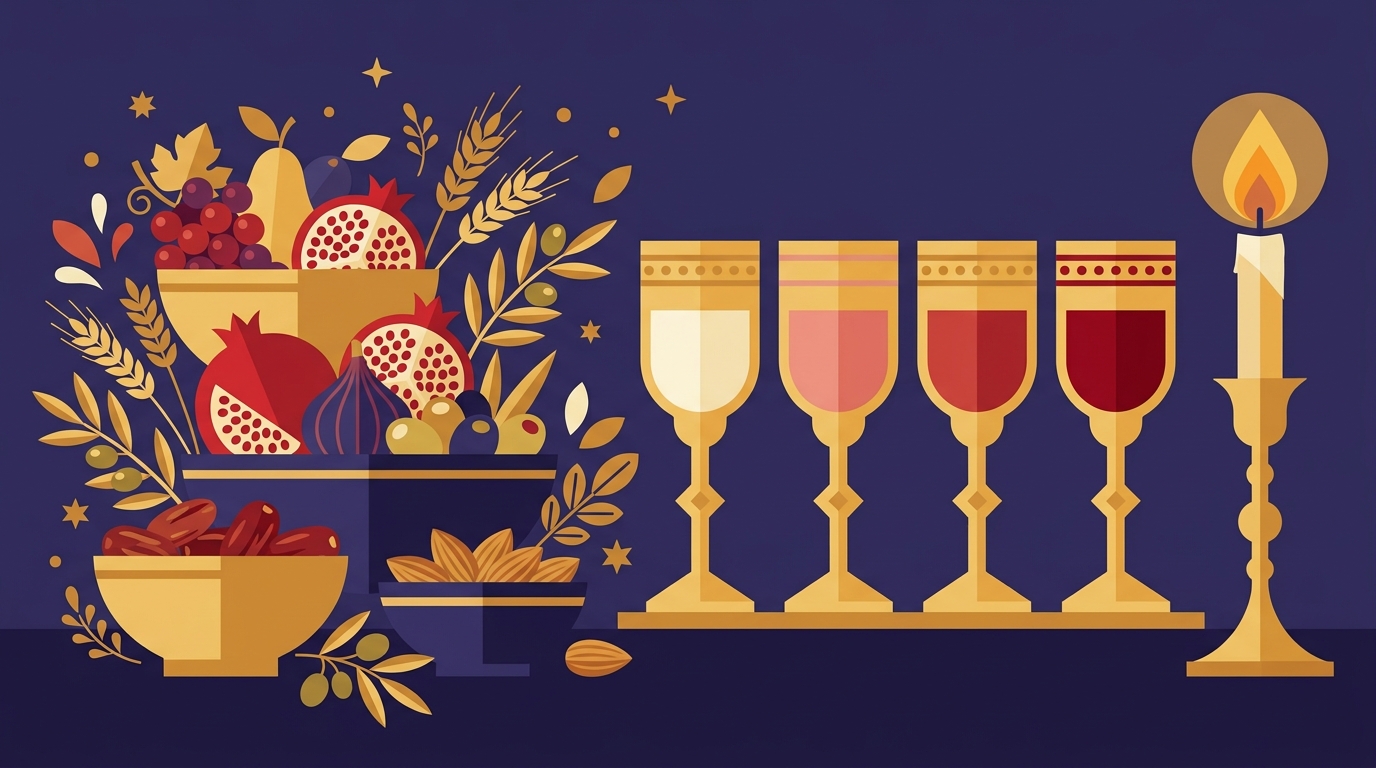
The seder uses four cups of wine, in the manner of the Pesach seder. The first cup is white. Each following cup has a little more red in it, until the last is entirely red. The Kabbalists link the four cups to the four seasons, and to the four worlds of Atzilut, Beriah, Yetzirah, and Assiyah (see our article on The Four Worlds). The progression from white to red reflects the movement from the hidden to the revealed.
Three kinds of fruit
The fruit are grouped by the way they are protected. Some have a hard outer shell that is not eaten, such as nuts and pomegranates. Some have a pit inside, such as olives and dates. Some can be eaten entirely, such as figs and grapes. The Kabbalists correlate these categories with the levels of the spiritual realm and the degrees of the kelipot, the shells that conceal holiness (see Kelipot and Nogah). The order of eating moves from the most covered to the least.
It is customary to include the Seven Species with which the Torah praises the Land of Israel (Devarim 8:8): wheat, barley, grapes, figs, pomegranates, olives, and dates, and to say the proper blessings on each.
What the seder teaches
The Torah compares a person to a tree of the field (Devarim 20:19). The seder takes this comparison seriously. A tree has roots that draw from the earth, a trunk that carries, and fruit that gives, and the Kabbalists see the same pattern in a person. At the beginning of the winter, when the trees look bare, the season of their renewal has already begun below the surface.
The seder is held on the evening that begins the fifteenth of Shevat. For the month as a whole, see The Awesome Significance of the Month of Shevat.