


Most descriptions of the Mishkan (Tabernacle) are detailed but plain. The Menorah is different. The Torah says it was to be made of one piece of pure gold, hammered into shape, with six branches coming out of a central shaft, each one carved with cups, buds, and flowers (Shemot 25:31-40). The Sages tell a story that even Moshe could not at first understand how it should be made, and that he was shown an image of fire from Heaven (Menachot 29a, with Rashi on Bamidbar 8:4). The Kabbalists have long read it as a figure of the structure of the Divine.
What the Torah says
The Menorah stood in the Heichal (the sanctuary), on the south side, opposite the Table. It held seven lamps, and every day the Kohen cleaned them and trimmed the wicks and refilled them with pure olive oil (Shemot 27:20-21, Bamidbar 8:1-4). One detail stands out in the text: the six outer lamps face toward the middle one (Bamidbar 8:2, “toward the face of the Menorah the seven lamps shall give light”).
The western lamp
The Talmud notes that the westernmost lamp, the ner ma’aravi, burned longer than the others. It was lit first and extinguished last, and it was a testimony to everyone that the Shechinah (Divine Presence) rested in Israel (Shabbat 22b). The Sages then ask the question that the whole Menorah raises: “Does He need the light?” The One who gave light to all the world in the wilderness does not need a lamp. The lamp is for us.
Seven lamps and seven sefirot
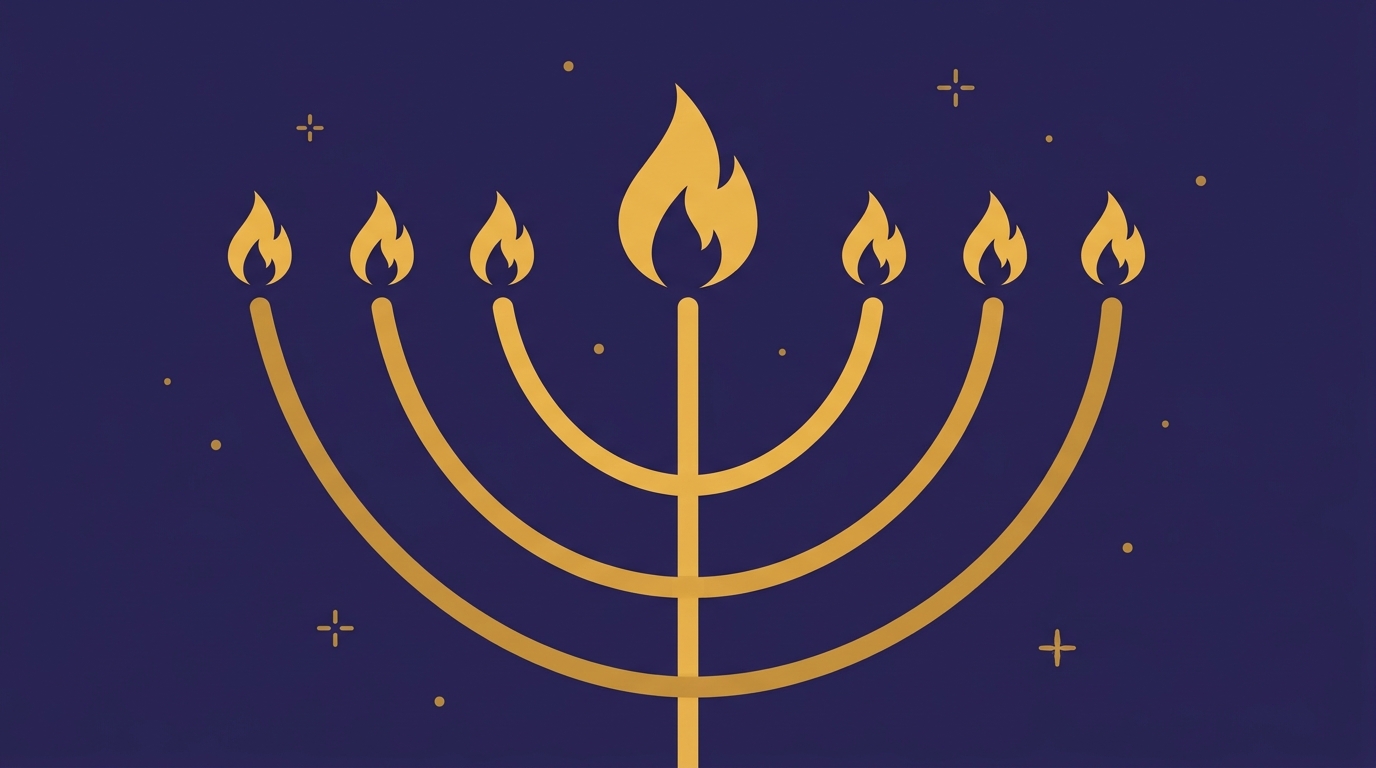
The Kabbalists link the seven lamps to the seven lower sefirot (Divine attributes): Chesed, Gevurah, Tiferet, Netzach, Hod, Yesod, and Malkhut. These are the attributes through which the Divine acts in the world. The assignment of each lamp to a particular sefirah varies among the sources, and a reader should not take one diagram as the only one. What holds across the different readings is the image of a central lamp that gathers the others, with three on one side and three on the other.
The fact that the lamps face the center fits this reading. Each attribute, taken alone, is partial. Kindness without strength overflows, and strength without kindness destroys. The attributes need a center toward which they turn, and from which they receive balance. In our article on Tiferet, this central role is described in more detail.
One piece of gold
The Torah’s insistence that the Menorah was made from a single block of gold also has a meaning in this reading. The seven lamps look separate but are one object. In the same way, the sefirot appear as distinct qualities but are a single Divine light seen through different openings.
The Menorah today
The Menorah of the Temple has not been in use since the Temple was destroyed. The Talmud forbids making a replica of it with seven branches for ordinary use (Menachot 28b). The Menorah lit by Jewish families on Chanukah is a different object, with eight lights plus the helper. The prophet Zechariah saw a golden Menorah with two olive trees beside it, and was told, “Not by might and not by power, but by My spirit” (Zecharyah 4:6), which is read on the Shabbat of Chanukah. The connection has been noted in our article on Kislev and the Light of Chanuka.
Why it matters
Each morning the Kohen cleaned the lamps and trimmed the wicks, and each evening he lit them. He prepared the lamps and the oil. The light was not his to make. The Kabbalists describe a person’s service in the same terms. The Kohanim who tended the lamps also gave the Priestly Blessing, and the Ramchal’s account of the Temple service is in his insights on the Beit HaMikdash.